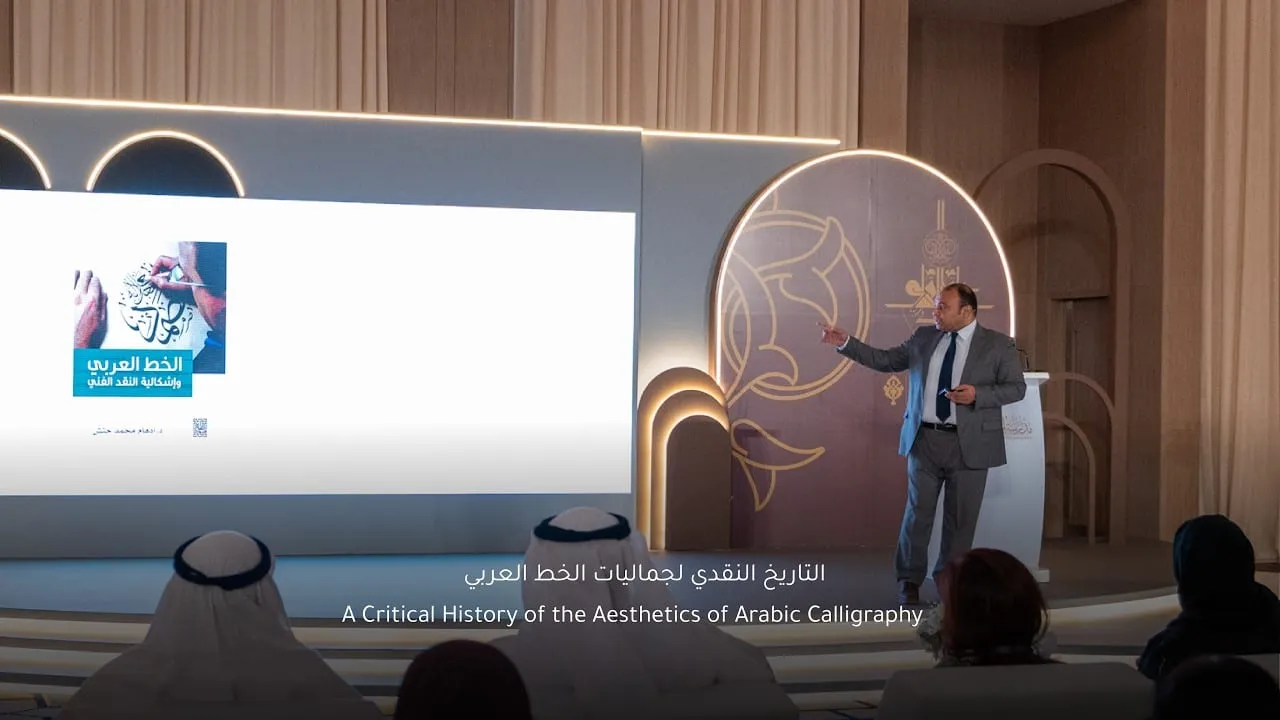
Dr. Mohamed Hassan took part in this dialogue organized by the AUC Type Lab (American University in Cairo), moderated by Ms. Bahia, with the participation of Dr. Azza Ezzat (head of the Center for Writing and Calligraphy Studies at the Bibliotheca Alexandrina). The dialogue addresses the evolution of the curricula and methods of teaching Arabic calligraphy, from the traditional systems based on rote learning and imitation to the modern pedagogical curricula, with a focus on the importance of typography and page layout in educational materials directed at children and young learners. What follows is a structured record of its main themes, allowing it to be read as a text alongside watching it in full in the video above.
Part One: The Work of the Center for Writing and Calligraphy Studies at the Bibliotheca Alexandrina
Speaker: Dr. Azza Ezzat
The Center for Calligraphy Studies at the Bibliotheca Alexandrina was founded in 2003 and is concerned with the study of writings, inscriptions, and scripts across the ages, from the pre-dynastic period to the digital age. The center aims to organize workshops, conferences, and seminars, in addition to publishing specialized scholarly books.
Prominent Projects and Publications
- Teaching the young: the center published the book “Words from Life in Ancient Egypt” to teach hieroglyphic writing to children (ages 9 to 15), in both Arabic and English. It relies on simplifying the hieroglyphs by linking the pictorial signs (inspired by nature and animals) to the life of the ancient Egyptian, making it visually and cognitively engaging material.
- Academic research: the center issues a peer-reviewed journal entitled “Abgadiyat Journal,” which receives specialized research on inscriptions and writings in Arabic, English, and French.
- Online resources: the center launched an electronic platform to teach hieroglyphs to adults, including the first interactive electronic dictionary of hieroglyphic signs in Arabic, in addition to a section dedicated to precise references for researchers.
Part Two: The Methodological Shifts in Teaching Arabic Calligraphy
Speaker: Mr. Mohamed Hassan
Grasping the future of Arabic calligraphy, type design, and typography requires a deep understanding of the roots of the calligraphic heritage and how it was taught and how it developed.
The Sufi and Philosophical Roots of Arabic Calligraphy
Arabic calligraphy was tied in its origins to Sufi thought, where letters were viewed from a spiritual perspective (such as considering the alif a “luminous letter”). These philosophical dimensions (such as the abjad numerical reckoning) shaped the awareness of the early calligraphers and founded their aesthetic outlook.
The Mamluk Era and the System of the “Calligraphic Ijaza”
In the Mamluk era, names such as Ibn al-Sayigh emerged (author of a treatise on the script and the trimming of the pen), who offered a pioneering scholarly formulation for teaching calligraphy. In this context appeared the system of the calligraphic ijaza (license), a kind of academic certificate (akin to a doctorate) granted to the student after he progresses through a hierarchical structure of training, imitating the types of scripts and mastering their aesthetics, concluding with a ceremony in which the masters sign his panel, qualifying him to be a master calligrapher.
The Ottoman-Egyptian School and the “Mashq” Tradition
In the late nineteenth and early twentieth centuries the Ottoman school dominated, and teaching relied on the system of “mashq” (visual imitation and repeated practice).
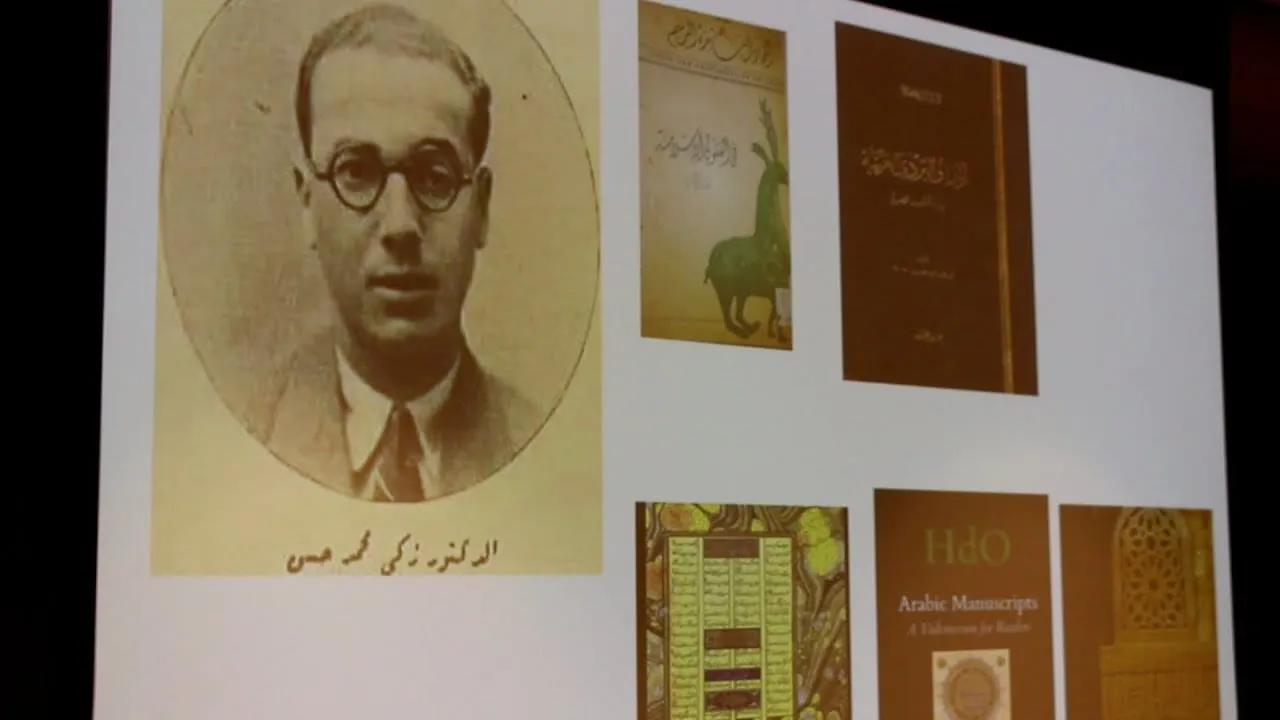
- The mashq copybooks: the copybooks of pioneers such as Muhammad Shawqi (for Naskh and Thuluth), Mustafa Halim (for Diwani and Ruqʿa), Najib Hawawini (author of the “golden chains”), and Ahmad al-Husseini Abu al-Roos stood out.
- The traditional method: mashq relies on writing the single letter, then its connections with the other letters, then writing complete texts (such as the Burda poem). Despite the importance of this method, it constrained the educational path in a single direction (imitating the supple letters and neglecting the rigid ones such as Kufic and square Kufic).
The Pedagogical Shift and the Development of Calligraphy Curricula (Structural Elicitation)
A methodological shift occurred to move away from the idea that “imitation alone suffices,” and the focus began to be placed on establishing philosophical and pedagogical frameworks for teaching calligraphy:
- Muhammad Mu’nis-zadeh: in his book “The Familiar Balance in the Placement of Words and Letters,” he offered an encyclopedic vision explaining the proportions of the letters and their geometric anatomy.
- Abd al-Razzaq Salem: he brought about a leap in the teaching of calligraphy through the “al-Hadi” series and the book “The Special Methods in Teaching Arabic Calligraphy”; he relied on “eliciting the letter” (analyzing the calligraphic structure), used two-color printing to clarify the directions of the pen and the points of connection, and discussed the differences between Arabic script and English script.
- Fuad al-Ibani: he offered a practical step by producing copybooks for teaching calligraphy using an “ordinary pen” (not the calligrapher’s pen/nib), to suit the needs of school students.
- Tahir Jaafar al-Agha: he authored a book on the anatomy and critique of the Ruqʿa script, considered a continuation of the analytical school, but which unfortunately did not gain wide circulation.
The Role of Reading in Building Visual Memory
The teaching of calligraphy was not limited to the mashq copybooks but extended to children’s stories and reading books. In the 1940s and 1950s, the task of writing children’s stories (such as the publications of Maktabat Misr and the books of Miss Ihsan Muhammad Abu Zob) was entrusted to great calligraphers such as Mahmoud al-Shahhat, Najib Hawawini, and Sayed Ibrahim. Writing the titles in Thuluth and the body text in vocalized Naskh contributed to nourishing the child’s visual memory and elevating his aesthetic taste, without the need to teach him the rules of calligraphy in a dry manner.
Global and Contemporary Experiences in Teaching Calligraphy
To advance the teaching of calligraphy, one must be open to modern experiences:
- Bilingual design: as in some German-Arabic editions of children’s stories (such as the stories of Jalal al-Din al-Rumi), where the designer adapts the scripts to suit the visual spirit of the page.
- Modern Arab experiences: the efforts of the “Kuwait Center for Islamic Arts” in simplifying the rigid scripts (such as square Kufic) for children using stickers and color analysis.
- The Iranian school: using visual analogies from nature to explain the curves of the letters to children.
- The British Museum: its publication of the book “Arabic Calligraphy” to teach the script to non-Arabic speakers, distinguished by analyzing the letter into movement strokes, explaining the dot-proportion system, and clarifying the form of the letter (isolated, initial, medial, and final), one of the most important references for designers and calligraphers today.
Concluding Recommendations and Proposals
To develop the teaching of Arabic calligraphy and the design of educational materials in the Arab world, the following is proposed:
- Involving art-education teachers: not confining the teaching of Arabic calligraphy to the Arabic-language teacher alone; rather, the art-education teacher should have a fundamental role in teaching the aesthetic and visual aspect of the letters.
- Setting strict standards for children’s books: the child’s book should be subject to strict publishing policies regarding design, scripts, and page layout, with the possibility of reprinting the heritage reading books written in the hands of the great masters.
- Joining efforts: creating spaces of collaboration between pedagogues, typographers, and calligraphers.
- Academic openness: studying how Latin scripts and typography are taught abroad, and drawing out the methodologies that can be applied to develop the teaching of Arabic calligraphy with a contemporary perspective that does not compromise its authenticity.