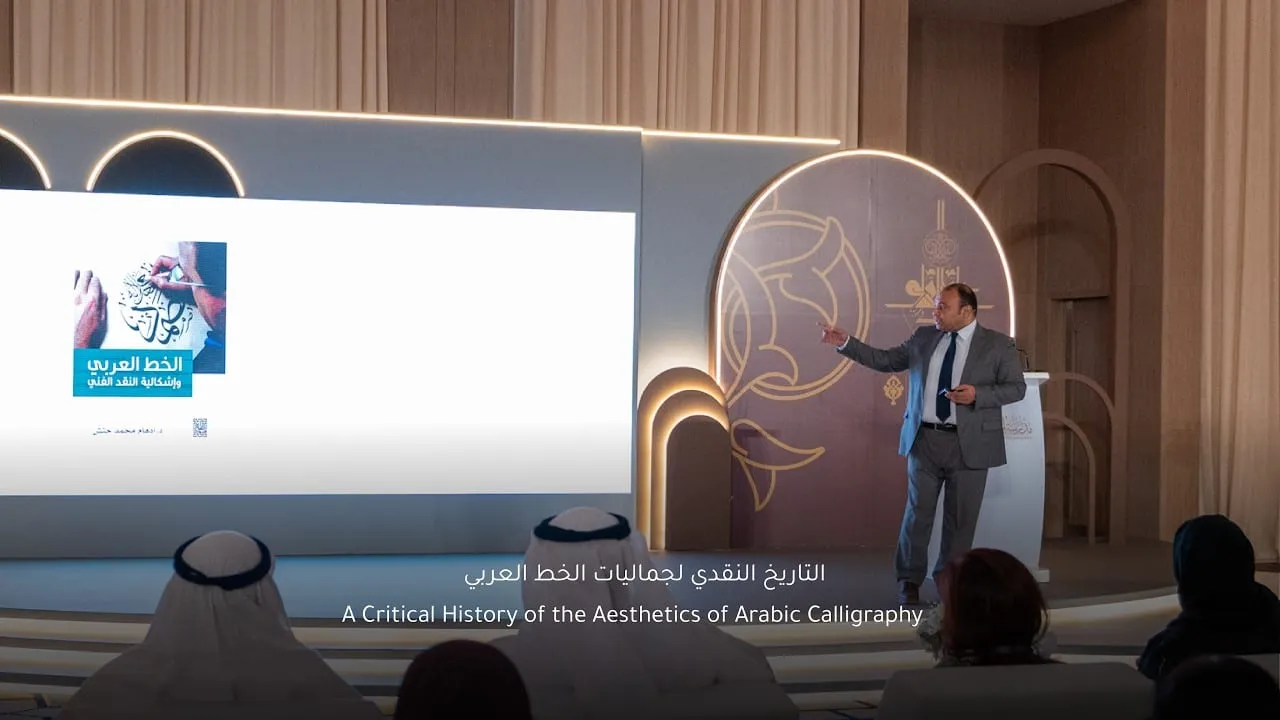
This lecture was delivered at the Department of Culture and Information in Sharjah. What follows is a structured record of its main themes, allowing the lecture to be read as a text alongside watching it in full in the video above.
Introduction: Between Theory and Practice in the Study of Arabic Calligraphy
In the humanities, the harmony between “theory and practice” is a matter of great importance. This lecture sought to apply the concept of the “calligraphic school” (its forms, its types, and its knowledge orientations) in a practical way, so that a complete, measurable vision takes shape, one fit to serve as a standard for evaluating art and beauty in Arab-Islamic civilization.
Theme One: The Problem of the Concept of the “Calligraphic School” and Its Classifications
Researchers (in the fields of archaeology, documents, and scripts) differ in their definition and delimitation of the concept of the “calligraphic school” according to their knowledge backgrounds. These schools may be divided according to several criteria:
1. Historical and Stylistic Classification (by era or script form)
- By type of script: such as the Kufic school (with its various patterns and developments).
- By era: such as the Mamluk school and the Ottoman school (in theory, production, and philosophy).
- By the nature of the script: dry (rigid) scripts versus supple ones.
2. Functional Classification (by the purpose of the writing)
- Architectural scripts (Inscriptions): the writings executed on buildings and monuments.
- Document scripts (Diplomatics): the scripts used in the chanceries and transactions.
- Qur’anic scripts: a field currently witnessing a research surge thanks to the archaeological discoveries of the parchment codices of the first centuries.
- Manuscript scripts (Manuscripts): the study of the forms and orientations of scripts within copied books.
Theme Two: The Research Approaches to Reading the Calligraphic Schools
The lecturer reviewed the most prominent academic efforts that have addressed the calligraphic schools:
- The comprehensive artistic school: represented by the Iraqi researcher Dr. Yusuf Mahmoud Allam in his book Art in Arabic Calligraphy, which offered a comprehensive survey study of the types of writing; despite its comprehensiveness, it focused heavily on architectural writings.
- The archaeological and Orientalist school: represented in the Arab world by Dr. Zaki Muhammad Hassan (in the 1920s), and the contributions of the Austrian scholar Adolf Grohmann (in the study of papyri). The Orientalist/archaeological mindset still dominates much of the research to this day.
- The contemporary Western school: in which the works of the researcher Sheila Blair stand out in the study of Islamic inscriptions and scripts, along with the research of Adam Gacek on Arabic manuscripts and the making of paper and binding.
Theme Three: Toward a Comprehensive Concept of the “Arab School of Calligraphy”
The lecturer formulated a comprehensive definition of the Arab calligraphic school as follows:
It is a set of artistic styles and orientations relating to the writing of Arabic calligraphy, which developed across the ages. This school was distinguished by the precise combination of the aesthetic aspect and the functional aspect, and it included patterns such as Kufic, Naskh, Diwani, Thuluth, and Ruqʿa. These patterns reflect the diversity of the cultures and local traditions of the societies that embraced Islam.
A civilizational significance: the diversity of the calligraphic schools (in North Africa, Transoxiana, and elsewhere) proves that Islamic civilization was not a civilization of closure or of imposing a single hue by the sword, but a civilization of dialogue, assimilation, and acceptance of the other, which allowed the emergence of calligraphic patterns influenced by the local cultures.
Theme Four: The Geographical Classification of the Calligraphic Schools
The calligraphic schools are distributed geographically into:
- The Hijazi school.
- The Kufic school.
- The Egyptian and Levantine school.
- The Persian school.
- The Andalusian school.
- The Maghribi school.
- The Ottoman school.
- The African school: (including Sudan and West Africa). The lecturer affirmed that the study of the manuscripts and tombstones in this region represents “the future of scriptural and calligraphic studies.”
Theme Five: Problems and Discoveries in the Early Scripts
1. The Problem of the Term “Hijazi Script”
- The lecturer clarified that the term “Hijazi script” is a purely Orientalist term, coined by the Orientalists to classify the very early scripts (before the crystallization of the Kufic script).
- An anticipated development: Arab and foreign researchers are currently making concerted efforts to deconstruct this term and develop it into its more precise designations (the Meccan script and the Madani script). The term “Hijazi” is expected to fade away within the next few years in favor of more precise scholarly terms.
2. The Archaeological Discoveries (the Sana’a Codices as a Model)
- In the 1970s, following the collapse of a wall in the Great Mosque of Sana’a, an enormous collection of early parchment codices was discovered.
- German research teams took charge of documenting and archiving this discovery, which raises a question about the role of the Arab universities, and makes it imperative for Arab research institutions to be more attentive and to take the initiative in leading the archaeological discoveries relating to their own heritage.
- These early codices prove that the Islamic mind opened up rapidly and developed to serve the “Book of God,” transforming from an oral mentality into a documentary civilization without stagnation.
3. The Papyri and Bilingualism (Early Coexistence)
- The papyri are an authentic source for understanding the development of early Arabic writing (Austria holds the “Archduke Rainer Collection,” one of the largest collections of Arabic papyri in the world).
- The civilizational significance of the papyri: many of these papyri display bilingual texts (Arabic-Greek, or Arabic-Coptic), confirming that the early Islamic administration was not a repressive authority that abolished the language of the other, but ran the state with a wide space of dialogue and shared coexistence (as documented by Ibn al-Nadim in al-Fihrist and studied by Dr. Ayman Fuad Sayyid).
Conclusion
The lecture affirms that Arabic calligraphy is not merely geometric forms, but a “civilizational document” reflecting the nature of thought, tolerance, and administrative and artistic development in Arab-Islamic civilization across the different ages and schools.