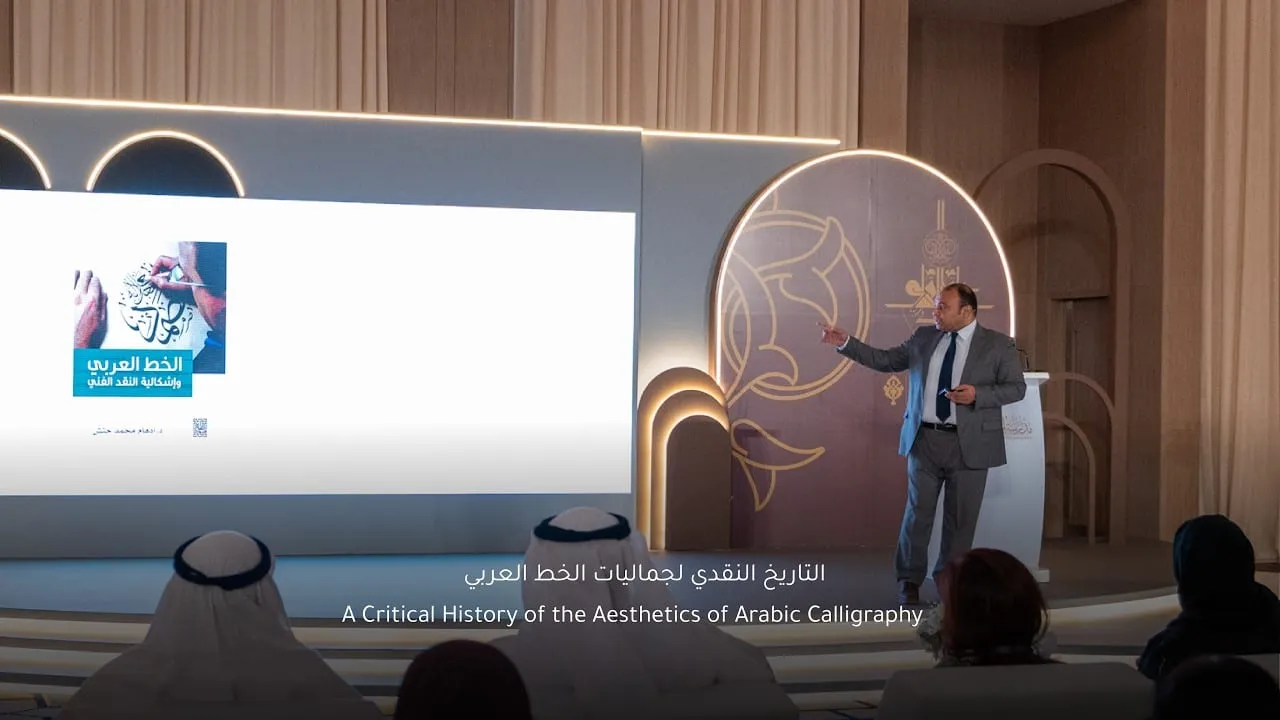
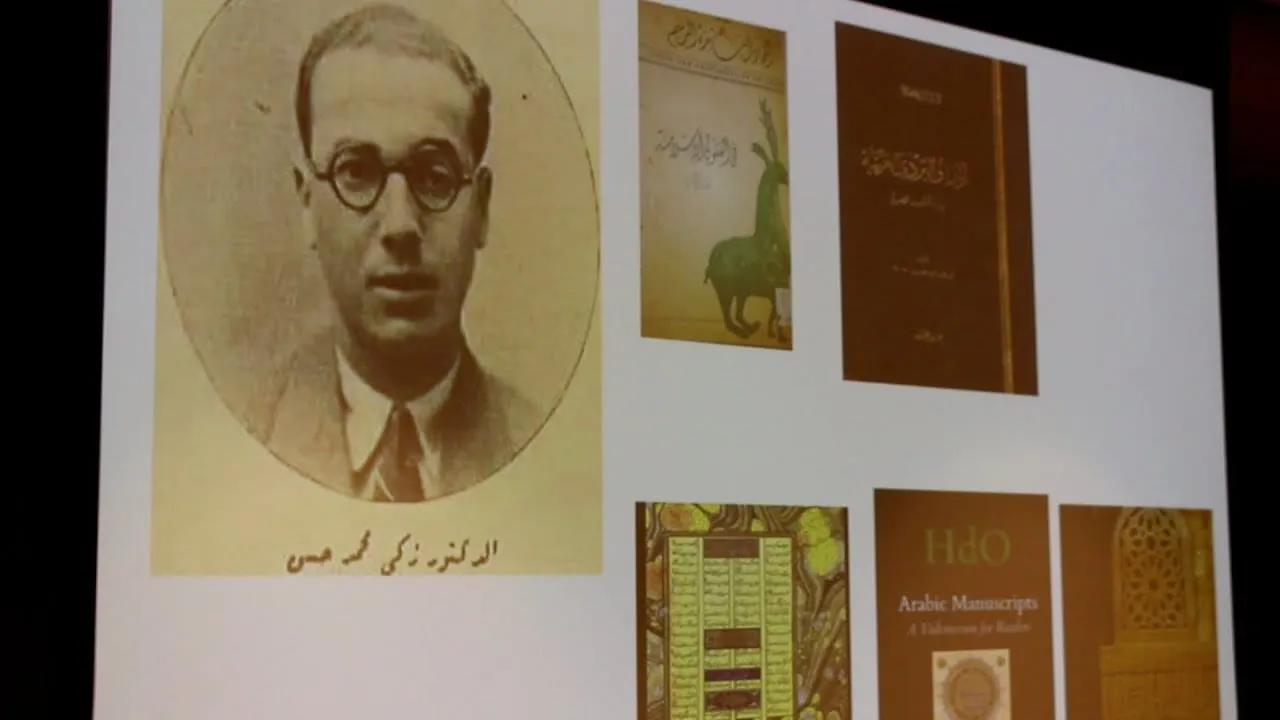
Dr. Mohamed Hassan took part in this symposium within the exhibition “The Journey of Writing and Script: Paths of the Spirit” (second edition) in Riyadh, moderated by Dr. Haytham Nawar (Associate Professor of Design at the American University in Cairo), with the participation of Dr. Lotfi Abdel Gawad (Head of Research at the National Heritage Institute in Tunisia) and Eng. Abdulrahman al-Shahed (calligrapher, plastic artist, and architect). What follows is a structured record of the symposium’s themes, allowing it to be read as a text alongside watching it in full in the video above.
Opening Remarks
This symposium comes in celebration of Arabic calligraphy as one of the most important imprints of Arab-Islamic civilization, and in coincidence with the inscription of “the skills and arts of Arabic calligraphy” on the Representative List of the Intangible Cultural Heritage of Humanity (UNESCO) in December 2021. The symposium aims to trace the path of Arabic calligraphy from its origins as a documentary tool, through its aesthetic and spiritual development in manuscripts and architecture, to its manifestations in the contemporary arts and its future in light of technology and artificial intelligence.
Theme One: The First Roots and the Origin of Arabic Writing (Dr. Lotfi Abdel Gawad)
Dr. Lotfi reviewed the historical and archaeological problems surrounding the origin of the Arabic letter and its development in the first three centuries of Islam:
1. The Significance of the Term “Arabī”
Some linguists hold that describing the Qur’an as “Arabī” is not confined to ethnic belonging (Arabness), but linguistically means “completeness, perfection, and freedom from deficiency and defect.”
2. Theories on the Origin of Arabic Script
- Ruling out the Musnad (Yemeni) script: contemporary scholars agree in rejecting the old reported theory (of Ibn Khaldun and others) that Arabic script descended from the “Musnad” or “Himyaritic,” given the stark difference in the form of the letters and their non-connection.
- A Syriac or a Nabataean origin?
- The Syriac theory: rests on the connection of the letters and their regularity on a straight line.
- The Nabataean theory (the more likely one archaeologically): is supported by the discovered inscriptions (such as the Umm al-Jimal inscription and the al-Namara inscription preserved in the Louvre), which reflect a sequential Arabic language and a clear semiotic development of the Nabataean letter in its late stages so as to become similar to the Arabic.
3. The Development of the Early Kufic Script (the First Three Centuries)
The early Islamic inscriptions developed in a rapid chronological sequence that reflects the awareness of Islamic civilization, and they divided into stages:
- The archaic documentary writing: free of ornament, its aim to convey information (such as the Salama inscription of 23 AH and the Zuhayr inscription of 24 AH).
- The perfected writing: distinguished by uprightness and precision (the imperial Umayyad script).
- The writing with terminal ornaments: the artist devised solutions to fill the voids between the letters by extending the ends of the letters and foliating them (palm fronds).
- The raised (carved) writing: it formed an artistic “revolution,” for carving around the letter and raising it (as opposed to sunken engraving) gave the artist immense freedom to shape the complex vegetal ornaments around the text and to avoid the errors of engraving.
Theme Two: The Calligraphic Schools and the Foundational Manuscripts (Dr. Mohamed Hassan)
The discussion moved to how the calligraphic schools are classified and how their trajectories are understood through the manuscripts and codices:
1. Building the “Calligraphic School”
The term “school” cannot be applied except when its elements are present together: (the inscriptions, the Qur’anic scripts, and the documents). The schools are classified geographically into (the Kufic, Egyptian, Levantine, Persian, Maghribi, Ottoman, and African schools).
Note: the term “Hijazi script” is an Orientalist term, and the modern academic orientation tends to replace it with “the Meccan script” and “the Madani script.”
2. The Early ʿUthmanic Codices and Their Development
Six copies of the codices attributed to the era of the Caliph ʿUthman ibn ʿAffan remain, distributed globally (Cairo, Istanbul, Tashkent, and Saint Petersburg). Comparing these codices reveals a clear development in:
- The structure of the letter and the inter-letter spacing.
- The absence of dots and pointing (the “bareness”).
- The appearance of the ornaments separating the verses (drawn flexibly from the arts preceding Islam as a kind of civilizational openness).
3. The Papyri and the Prophetic Documents
- The papyri (in the first Hijri century) played a role in proving Islamic civilization’s assimilation of the other, since some of them were written “bilingually” (Arabic/Greek or Arabic/Coptic).
- The Prophetic documents and letters formed an independent research field (as in the studies of Muhammad Hamidullah), for understanding the development of early diplomatic writing.
Theme Three: Calligraphic Practices from Heritage to Modernity (Eng. Abdulrahman al-Shahed)
Engineer Abdulrahman offered a dense panoramic vision (of 1,400 years) from the angle of the practitioner and artist:
1. The Development of Materials and Tools
- Materials: from rocks and wood, to leather (parchment), then the great revolution with the knowledge of “paper,” down to contemporary materials (iron, plastic, neon, and glass).
- Pens: the transition from the flat-nibbed (straight) pen to the oblique-nibbed pen, which brought about a revolution in the aesthetics of the letter.
2. Pivotal Milestones in the Anatomy of the Letter (the Attributed Script)
- The first three centuries (the measured script): it was measured by the “Tumar” pen (with a thickness of 24 hairs from a horse’s tail), and from it branched the scripts (Thuluth and Nisf).
- The fourth Hijri century (Ibn Muqla): he engineered the letters and established the “attributed script” (al-khaṭṭ al-mansūb), using the “circle” as a measure (inspired by the astronomical proportions and the proportions of the human body).
- Ibn al-Bawwab: he focused on perfecting sixteen fundamental pens.
- The seventh Hijri century (Yaqut al-Mustaʿsimi): he devised measuring the letter by the “dot,” increased the slant of the pen’s cut, and reduced the scripts to the “six pens” (Thuluth, Naskh, Muhaqqaq, Rayhan, Tawqiʿ, and Ruqʿa).
3. Contemporary Art and the Future (Artificial Intelligence)
- The technologies (such as printing and the computer) did not pull the rug from under the calligrapher, but helped him spread (printing disseminated the codices, and the computer created the art of typography).
- Conceptual, compositional art: the use of script in modern buildings and sculptures to create delight or a question.
- Artificial intelligence (AI): a great tool for scholarly research (such as using it to document and draw the trees of the calligraphers of Mecca throughout history, and to generate imagined images of their historical contexts).
Theme Four: Issues and Discussions
- The problem of academic fragmentation (isolated islands): the moderator raised the absence of communication between the students of manuscripts, archaeologists, calligraphers, and designers. The proposed solution: convening round-table dialogues that bring together the “leading specialists” from all fields to unify terminology (such as the disagreement over the definition of “Kufic script”), and publishing unified digital databases for young researchers.
- Dealing with the modern discoveries (the Birmingham codex as a model): an attendee asked about the absence of Arab cadres from leading the research (such as carbon-14 testing) on the early codices. The response: this is due to the absence of academic departments specialized in “codicology” and “paleography” in the universities of the Middle East, which leaves the arena to the scholars of “Egyptology” or other Orientalists.
- The conflict of “conservatives” and “innovators”: Eng. Abdulrahman affirmed that art needs both wings: guardians who preserve the classics, and innovators who plunge into the contemporary. But it is a condition that the innovator be a good student of the rules before he breaks them, otherwise innovation turns into “visual distortion.”
- Technology as an ally, not an enemy: in a closing intervention, the current fear of artificial intelligence was likened to the painters’ fear of the invention of the “camera” in the nineteenth century; the camera did not kill art but created the Impressionist school, and likewise technology today must be harnessed as a tool that stimulates new ways of thinking and visual imagination.
Conclusion
The symposium affirmed that Arabic calligraphy was never a rigid art, but a living being that breathes and evolves with the evolution of civilization; it began as documentation in inscriptions, then became geometric and spiritual in manuscripts, down to being a fundamental component of the contemporary architectural and digital visual arts.