The Mamluk manuscript and its various arts played an important role in shaping the form of the Arab-Islamic book, and greatly influenced the output of non-Muslims who lived under the Islamic state.
The Mamluk manuscript was indeed highly distinguished; yet the splendor of the Mamluk Qur’anic manuscript in particular, especially what was written for the sultans, has taken much of the field of study, and there is no doubt as to its beauty and importance.
The Mamluk literary manuscript, by contrast, has not received that same measure of paleographic study.
Perhaps the most prominent study to appear on the Mamluk manuscript, marked by genuine research vitality, is that of Prof. Dr. Seham Mohamed Mahdi, may God bless her, on bookbinding in the Mamluk era.
But I am convinced that the cover page (frontispiece) of the Mamluk manuscript had an enchanting effect on the course of the making of the Arab book. Each time I look at the splendor of a design, the precision of the ornament, and the beauty of the letters, I find that the matter calls for a corpus and a study, or at least a compendium, documenting “the cover page in the Mamluk manuscript”: telling of its masterpieces, the story of its author and his dedication, and the library for which it was written, if the manuscript was a treasury (royal) copy.
And how the six pens (Thuluth and Naskh, Muhaqqaq and Rayhan, Riqaʿ and Ijaza (“Tawqiʿ”)) harmonized with the Kufic script in a panel complete in its elements and its meanings.
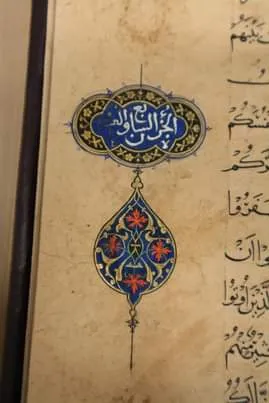
Attached is a cover panel from the manuscript “Ijtimaʿ al-Shaml fi Tariq ʿAmal al-Raml” by Muhammad ibn Ahmad al-Hasani al-Mukattib, all in the author’s own hand, a unique copy made as a dedication.
This magnificent volume was written in the year 883 AH / 1478 CE for Yashbak min Mahdi, who held the office of amir silah (master of arms) and grand dawadar in northern Syria. Arthur J. Arberry (who compiled the catalogues of the Chester Beatty Library) says: “…it appears that this volume, which contains a treatise on geomancy, was compiled with Yashbak’s last campaign in the author’s mind. The author described himself, in his beautiful hand, as the pupil of his uncle Sheikh Burhan al-Din al-Mukattib.”
The panel is one of many scattered panels that open the door to speaking of the Mamluk mastery that the making of the Arab book witnessed in Egypt and Syria under the Mamluk state.
- Attached is a link to a book gathering the papers of the conference “The Study of Islamic Manuscripts between the Considerations of Material and People,” held in London in 1993. It contains an article on the characteristics of manuscript binding in the Mamluk era, by Dr. Seham al-Mahdi.