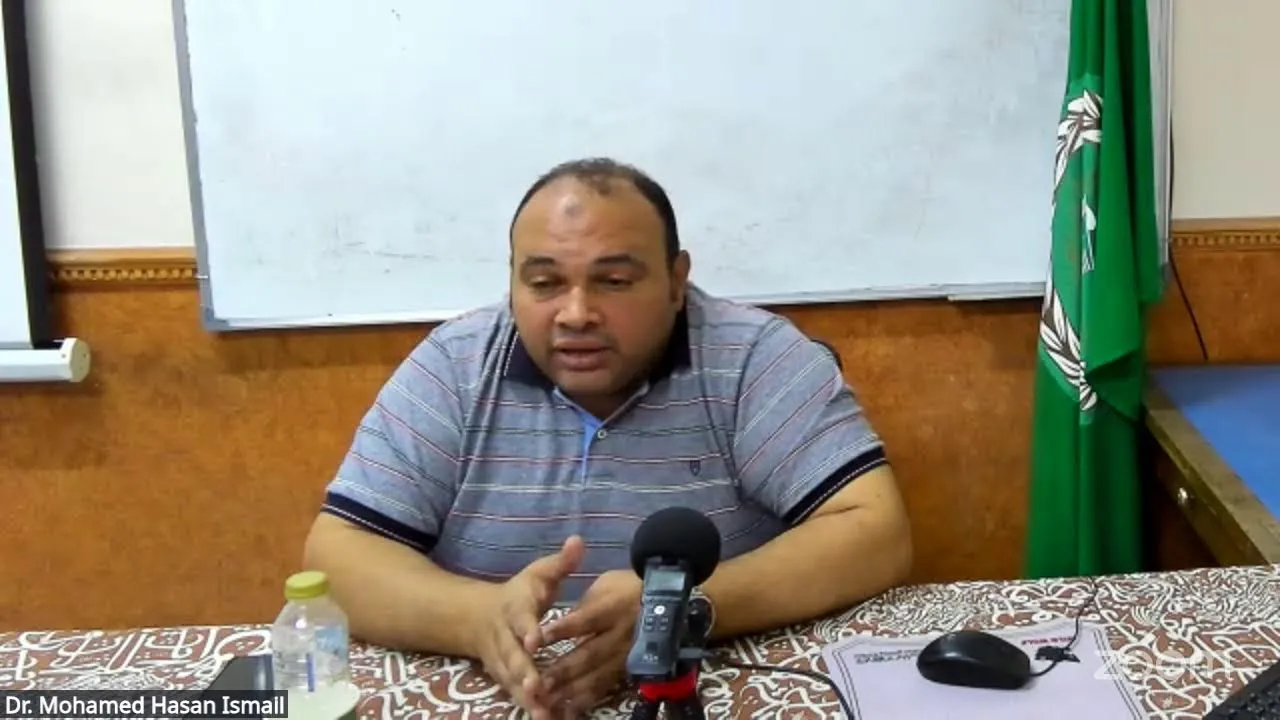
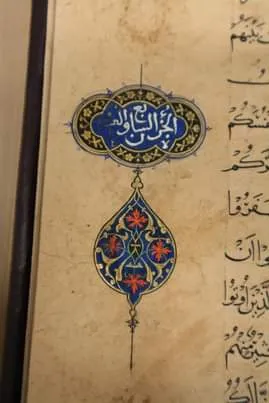
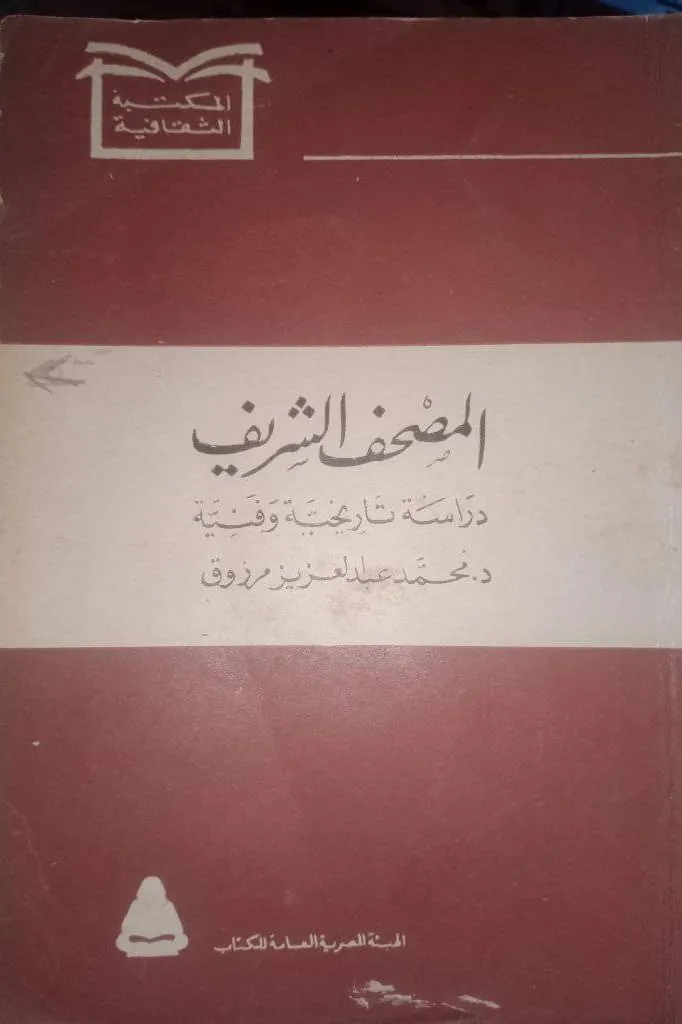
This lecture was delivered within the sessions of the “Script, Text, and Civilization” program at the Center for Islamic Arts Research and Applications (ISMAR) of the Fatih Sultan Mehmet Waqf University in Istanbul, in a conversation moderated by Dr. Ahmed Lamine al-Zaidi and hosting Dr. Mohamed Hassan (academic researcher and expert in manuscripts and Arabic calligraphy). What follows is a structured record of the lecture’s main themes, allowing it to be read as a text alongside watching it in full in the video above.
Introducing the Speaker
The session opened with congratulations on the occasion of Eid al-Adha, followed by an extended review of the biography of the speaker, Dr. Mohamed Hassan (born in Egypt in 1983), who combines the artistic practice of calligraphy with in-depth academic research:
- Academic qualifications: a master’s degree on “Writing and Scribes in Fatimid Egypt” (with distinction), and a doctorate on “Chancery Writing in the Age of the Mamluk Sultans” (with distinction and first-class honors).
- Scholarly and international participation: he took part in international forums for Islamic arts and Arabic calligraphy, including the Kuwait forum (2010) and the Sharjah forum (with a lecture on Arabic calligraphy in the family of Muhammad Ali), and chaired a number of the scholarly committees of the Cairo International Forum for Arabic Calligraphy from its third to its tenth session.
- Publications: The Register of Arabic Calligraphy in Egypt, The Biography of the Doyen Calligrapher Sayed Ibrahim, Masterpieces of the Egyptian School of Arabic Calligraphy, The School for the Refinement of Arabic Scripts, and a book on the head of Egyptian calligraphers, Khudair al-Borsaidy.
- Academic and advisory roles: teaching the course “Arabic and Islamic Manuscripts” at the Institute of Arab Research and Studies (since 2012) and the Institute of Arabic Manuscripts (since 2013); advisory duties at the Prince Mohammed bin Salman Center for Arabic Calligraphy (since 2022); and serving as an artistic advisor to the Diriyah Biennale Foundation (the Islamic Arts Biennale) in its first edition in 2023.
- Academic supervision: he supervised scholarly theses including “The Mashriqi Script: A Descriptive Analytical Study in Light of the Development of Arabic Script” (2024), “The Script Patterns of Libyan-Maghribi Manuscripts: A Comparative Analytical Study” (2022), and “Forgery and Examination in Arabic Manuscripts” (2022).
- Artistic licenses: he holds the traditional license of excellence and the Egyptian chain of transmission (isnād) in the Arabic scripts and their history from the master of Egypt’s calligraphers, Khudair al-Borsaidy (2024).
The General Framework and Methodology of the Lecture
Dr. Mohamed Hassan explained that the study of the “Umayyad Qur’anic codices” is characterized by complexity, given the abundance, diversity, and dispersal of the scholarly material. He divided the structure of the lecture into three fundamental themes:
- A review of previous studies: to understand the intellectual sequence of the development of Arabic paleography and the intellectual backgrounds of the Orientalists.
- The state of contemporary studies of the Umayyad codices: to grasp the nature of the material, its development, and the current research foundations.
- The anticipated horizons of development: in the field of early Qur’anic studies and the intersection of the sciences.
Theme One: Periodization and the Development of Orientalist Studies
The speaker divided the history of interest in the early codices into pivotal stages and milestones:
The Stage of Travelers and Diplomats
This stage witnessed the first beginnings of interest in acquiring manuscripts from the East. Among its most prominent figures was the explorer Carsten Niebuhr, who during his travels in the Arabian Peninsula gathered calligraphic pieces, tried to imitate the old Kufic writing as he observed it, and documented tombstones and the inscriptions on architecture (funerary and civil).
The Stage of Academic Foundation (Early Twentieth Century)
The Orientalist Alphonse Mingana stood out here; he gathered an enormous collection of Eastern manuscripts and in 1914 published a study at the University of Cambridge entitled “The Pre-ʿUthmanic Qurʼan.” Its importance lay not in any categorical claim but in being a “research hypothesis” that founded the modern methodology through: the use of facsimile images, the noting of textual-linguistic differences, and attempts at codicological reading (analysis of parchments and inks).
The Stage of Establishing Comparisons (Adolf Grohmann)
In 1958 the brilliant Austrian scholar Adolf Grohmann, author of the six-volume encyclopedia on papyri, published a pivotal article entitled “The Problem of Dating Early Qurʼans”:
- It laid down a comparative methodological framework between the Qur’anic texts on parchment, and inscriptions and administrative papyrus documents.
- Grohmann pointed out that the appearance of verse-ending and tenth-marker signs dates to the end of the first Islamic state and the beginning of the Umayyad era.
- He drew attention to a long Qur’anic passage written on papyrus in an early Hijazi script whose letters are marked by their slant.
- He discussed the Orientalist views on the basmala based on what appears in Ibn al-Nadim’s al-Fihrist, in a refined academic dialogue.
The speaker cautioned that Grohmann’s article must be re-read today, because the images he relied on were poor (black and white), whereas high-quality imaging techniques are available today that reveal details previously invisible (citing the efforts of Dr. Asma Hilali in reading the Sana’a palimpsests through backlit images of the parchment).
The Stage of Modern Cataloguing and Periodization (Déroche and Those After Him)
In 1983 François Déroche produced his catalogue, in which he sought to formulate a conception of the scripts of the early Hijazi period using the methodology of posing “problems” in description and dating. This was followed by the entry of Muslim researchers, such as the Iranian al-Mahdi in his book Satr al-Mastur, and David James in his research on the Mamluk codices.
Theme Two: The Umayyad Codices (Concept, Characteristics, and Associated Sciences)
Historical definition: these are the codices written or copied during the Umayyad era (between the years 41 and 132 AH), representing the “third project” of the noble codex (borrowing the term of Dr. Omar Hamdan). After the first collection project (Abu Bakr al-Siddiq) and the second (ʿUthman ibn ʿAffan), the third, Umayyad project came under the leadership of al-Hajjaj ibn Yusuf al-Thaqafi in the reign of the Caliph ʿAbd al-Malik ibn Marwan, known for his civilizational vision. This project concerned itself not only with the text but with “presentation, page organization, ease of reading, and the development of the vocalic marking”, and this period also witnessed the appearance of the earliest books on the science of readings (qirāʼāt) and the science of verse-counting.
The nature of the Umayyad codices: the majority were written on parchment in the “Hijazi script” through its stages, then the “early Kufic” patterns began to appear at the end of the Umayyad era. They range between near-complete collections (which are rare) and scattered fragments and folios dispersed across the libraries and museums of the world.
The fundamental sciences for studying them (the intersection of knowledge):
- Paleography: the science of the development of script, determining its period, the composition of the line, and the evolution of letters from the plain script to the Hijazi and others; it relies not only on the researcher’s culture but on references and sources.
- Codicology: the science of analyzing the material carriers (papers, parchments, inks, and the paratext).
- Philology: as related to codices it means the science of ʿUthmanic orthography, verse-counting, and tenth-marking; whereas in the papyrus documents it means the study of measures, weights, place-names, and the development of agricultural space. Reference was made here to an article by the Moroccan researcher Dr. Ahmed al-Saidi in al-Faisal magazine on the transformation of this concept into heritage editing.
- Art history.
- Carbon analysis.
The problem of the “Hijazi script”: the speaker affirmed that the term “Hijazi script (Meccan and Madani)” is a generalizing Orientalist term, and that more important than the label is observing three essential traits that emerged in the Umayyad codices:
- The appearance of personal execution: a space emerged for the personal judgment of the copyist/calligrapher (Grohmann proved this by comparing the Parisian codex with the Ihnasia papyrus and the Zuhayr inscription).
- The appearance of local styles: the variety of the scribes’ methods according to their provinces.
- The civic nature of the script: the Hijazi script was not originally a “religious script” confined to codices, but a civic script in which all media and documents were recorded.
Theme Three: The State of Contemporary Studies of the Umayyad Codices
The speaker reviewed a map of the most important contemporary researchers who addressed the concept of the “Umayyad fragment” explicitly:
- Prof. Ghanim Qaddouri al-Hamad: a pioneer with a great contribution to the studies of Qur’anic orthography (since his doctoral dissertation in the 1970s); he is distinguished by linking the heritage sources with the Qur’anic inscriptions discovered in Saudi Arabia, and presenting the concepts of orthography in a way that suits the present moment.
- Prof. Omar Hamdan (University of Tübingen, Germany): he published a foundational article entitled “The Second Codices Project in the Umayyad Era”; he re-read the history of the codex, highlighted the role of al-Hajjaj ibn Yusuf, linked the reading to the orthography and the vocalization (the dotting/iʿjām), employed the Arabic heritage sources with a critical method, and highlighted the relationship between the center (the capital) and the provinces (Basra and Kufa). He also launched the series “From the Ancient Codices” on his academic page, in which he studied the “Chester Beatty parchment” in Ireland, defining the aims of the Umayyad project: the dotting of similar letters (bāʼ, tāʼ, jīm…), fixing the number of words, separating the verses (fifth- and tenth-marking), and dividing the Qur’an into parts.
- Professor Yasin Dutton: he has an important 2003 study addressing an Umayyad Qur’anic fragment that was recently sold at Christie’s auction house for a huge sum (£381,000, despite an estimate of £200,000 to 300,000). He relied in dating it on the shape of the page (vertical), the verse-counting signs, and the “hardening” that befell the Hijazi script (the straightening of the letter and the loss of its slant). He showed that the fragment belongs to a group transferred from the Great Mosque of Homs to the Museum of Turkish and Islamic Arts (TIEM) in Istanbul, with parts of it in America and the Baghdad library.
- Prof. Bashir al-Humairi: he presented a sober, exemplary descriptive-analytical study of the Tübingen University codex.
- François Déroche: author of the reference work “The Qurʼans of the Umayyads” (translated into Arabic by Dr. Hossam Sabry), who studied four collections (the Parisian codex, Sana’a, the ʿAmr ibn al-ʿAs Mosque, and the Kairouan palimpsests):
- The Parisian codex (Parisino-petropolitanus): a codex assembled from four places (the National Library of France, the Vatican, the Russian library, and the Nasser Khalili collection in London); the Orientalist Jean-Joseph Marcel transferred parts of it during Napoleon’s campaign (1798), and others went out in 1822 to Russia. It displays a Hijazi script written by several different hands, indicating the absence of a strict standard at that time (the copyist’s freedom), and it is distinguished by the appearance of the vegetal ornamental roundels separating the suras (the illuminations) as an early Umayyad trait.
- The Chester Beatty codex: Déroche considered it the turning point toward the “imperial governmental scriptorium,” where the copyist’s freedom disappeared and a strict adherence to defined rules and an official Umayyad vision appeared, with a clear emergence of the case-vowel and letter-distinguishing dots.
- Dr. Asma Hilali: reference was made to her book on the Sana’a codices, with a caution about the importance of reconciling paleographic studies with the artistic-aesthetic view of the manuscript.
- The researcher Éléonore Cellard: author of the term “Codex Amrensis”; she issued two volumes (the first in 2017 and the second recently) to study the codices discovered at the ʿAmr ibn al-ʿAs Mosque in Fustat, her methodology encompassing the history of the manuscript, codicological analysis, the scripts, the spelling, the vocalization, and monitoring the development of the form of the “lām-alif” letter. (Dr. Hassan noted here the necessity for Muslim researchers to confront the Orientalist doubts raised about the codices of the Companions.)
- Dr. Mohamed Hassan’s own research experience: he recounted the story of his discovery of a very small Umayyad Qur’anic fragment (about 6×14 cm) at the “House of Islamic Arts” (the al-Sayrafi family museum) in Jeddah; he conducted a process of “dialogue and collation” between it and Déroche’s book The Abbasid Tradition, and presented research on it at a conference at the Institute of Arabic Manuscripts in Cairo, explaining how the Umayyad script receded for political reasons to be replaced by the Abbasid Kufic script.
Recommendations and Conclusions
At the close of his lecture, Dr. Mohamed Hassan set out key recommendations:
- The continuity of research: the file of the Umayyad codices has not been closed; the existence of the parchments requires a parallel study of the papyri and a comparison between them, and we need re-cataloguing and re-reading based on the precision of modern imaging.
- Translation and access: the necessity of translating the European sources (such as the book Corrections in Early Qurʼānic Manuscripts) into Arabic and making them readily available to researchers, rather than remaining locked behind purchase and shipping.
- Praise for the institutions: he commended the contributions of the Al-Furqan Islamic Heritage Foundation in London (and its conference on the Qur’an in three volumes) and the IRCICA center.
- Cross-analytical linkage: the imperative of linking the manuscripts and Qur’anic palimpsests on the one hand with the civilizational studies of the “rock inscriptions” (the inscriptions of Mecca and the Arabian Peninsula) on the other, praising the efforts of the academics (Dr. Saad al-Rashid, Dr. al-Zayla’i, and Dr. Mishlih al-Muraikhi).
- The role of the “cultured calligrapher”: the researcher and calligrapher should not be confined to producing artistic panels, but should employ his expertise to produce academic scholarly material by making use of the available centers (such as the Prince Mohammed bin Salman Center for Arabic Calligraphy), recalling the experience of the calligrapher Yusuf Ahmad.
The Interventions and Discussion Session
The intervention of Dr. Ahmed Lamine al-Zaidi (the moderator): he observed in the Sana’a palimpsests, the Damascus folios (the Dome of the Treasury), and the Birmingham codex that the Umayyad letter-distinguishing dots appear as a “small dash” (resembling the modern fatḥa) written with the same writing pen, not a circle like the case-vowel dots of Abu al-Aswad al-Du’ali; he asked about the difference and the actual Umayyad contribution. He also observed in the Dome of the Treasury folios (at the TIEM museum in Istanbul and the Çamlıca museum) that the copyist places the single letter “hāʼ” as a marker denoting five verses (agreeing with the abjad numerical reckoning), asking whether these are individual variations.
Dr. Mohamed Hassan’s answer: he agreed that the Umayyad codices are a vast space for the personal judgment of the copyists, which explains the variation in the vocalization marks and the fifth-marking of verses; he affirmed that we have not yet reached a categorical, certain historical view of these signs, because the current survey studies are not comprehensive and lack an encyclopedic scope. He stressed the need for the archaeologist to cooperate with the cultured academic calligrapher to understand this development, noting that Grohmann devoted enormous studies to tracing the development of a single letter alone (such as the alif or the bāʼ).
A discussion of the problem of the “Qur’anic Kufic script”: Dr. al-Zaidi criticized the attempts of some contemporary calligraphers to “codify” the early Kufic scripts and to assume they are written with a strict geometric ruler, reducing them to a rigid mold that ignores the copyist’s freedom and the fluidity of the compositions (such as extending the nūn according to the space available in the line to avoid intersection). Dr. Mohamed Hassan strongly supported this view, describing the term “Qur’anic Kufic script” as a single geometric pattern to be “a mistaken view that cannot be relied upon,” and that the authority must lie with the archaeologists and cataloguers, calling for the “cultured calligrapher” who possesses the tools of collation to offer a scholarly vision that transcends rigid artistic codification.
The intervention of a Turkish researcher (via translation): have these codices been studied in terms of “the form and design of the page” (layout)? And is it conceivable that the extreme similarity in the forms of the letters resulted from a printing/stamping technique at that time? The speaker answered: studies of page design exist but are piecemeal, not a comprehensive survey; he explained that the shift to the “vertical format” with lines ranging between 20 and 30, and the straightening and hardening of the letter, is what represented “the maturity of the Umayyad codex and the imperial scriptorium,” and that as soon as authority passed to the Abbasids the design changed to the “horizontal format.” He ruled out the printing hypothesis, attributing the similarity to strict adherence to the standards of the “official imperial scriptorium,” which calls for a historical study of the methods of teaching and training the copyists in the Umayyad era.
The intervention of Mr. Abdullah al-Anazi: were the rules of the “Umayyad imperial scriptorium” confined only to the writing of codices, or did they extend to the rest of the state’s administrative correspondence? The speaker answered: for a precise answer the codices must be compared with the Umayyad administrative papyri (such as Geoffrey Khan’s studies of the Khurasan documents, and Dr. Said Maghawri’s studies of the Arabic papyri); and since the state created an official standard for the codex, it is quite logical that there was a strict protocol standard for its official documents between kings and commanders, while distinguishing these from the everyday scripts of popular transactions. Dr. al-Zaidi added that this unified vision became more institutional in the Abbasid era through the calligraphers of the chancery bureaus, specifically with the appearance of the “proportioned script” and then the “attributed script.”
The session concluded with thanks to Dr. Mohamed Hassan for this deep scholarly survey, and to Fatih Sultan Mehmet University and the ISMAR center, along with the announcement that the research, articles, and manuscript images referred to would be gathered and made openly available to researchers and attendees.