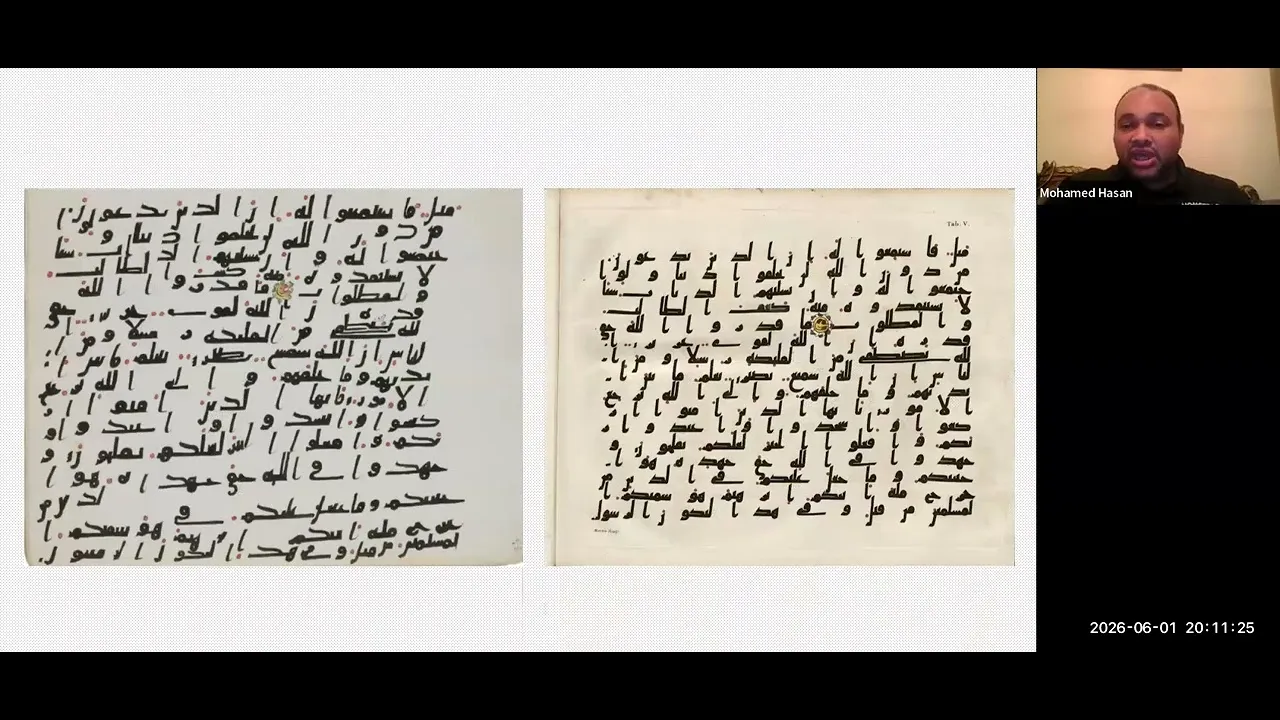
Dr. Mohamed Hassan (Mohamed Hassan Ismail) delivered this lecture within the 2025 courses of the Institute of Arabic Manuscripts, under the title “The Manuscript Codices: History and Codicological Dimensions,” offering a holistic view of the philosophy of the scripts of the noble Qur’an and their evolution. What follows is a structured, expanded record of its main themes, allowing it to be read as a text alongside watching it in full in the video above.
The transition of the Noble Qur’an from breasts to lines was not a mere mechanical act of recording, but an intense civilizational movement in which the efforts of the reciters, the scholars of orthography, the calligraphers, and the illuminators came together. The study of “the scripts of the noble codices” does not stop at the limits of surveying visual aesthetics; it is an investigation of the “mentalities” that engaged with the Qur’anic text across the ages. The design of the codex was subject to geographical, historical, and doctrinal factors: a codex written in Kufa differs in its visual structure from one written in Córdoba, Samarkand, or Timbuktu, reflecting a civilizational diversity united under the umbrella of the text’s sanctity.
The Major Drivers of the Evolution of the Qur’anic Script
The evolution of Arabic script in general, and the Qur’anic in particular, was subject to three fundamental drivers, in descending order of importance:
- The religious dimension (functional and fixing): the foundational driver. The greatest concern of the Companions and the Successors was to preserve the text in its revealed form, which is why the “science of ʿUthmanic orthography” arose as a faithful guardian of the text. The calligraphic development of the first centuries did not aim at ornamentation, but at preventing confusion (through dotting and pointing), facilitating reading, and safeguarding the text from corruption. Here function precedes beauty.
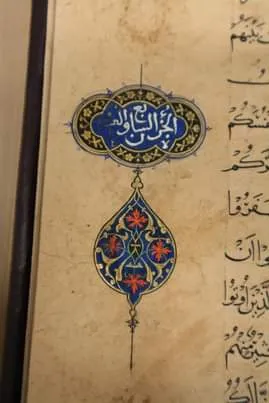
- The artistic dimension (aesthetic and geometric): with the stabilization of the text and the expansion of the Islamic state, the need for aesthetic expression emerged. Given Islam’s prohibition of figuration (animal and human representation), the Muslim artist found his outlet in the Arabic letter; the Qur’anic page became a space for innovation (layout design), and vegetal (arabesque) and geometric ornaments and illumination appeared, and the letters turned into miniature architectural structures.
- The historical dimension (temporal and geographical accumulation): every era added its imprint. The move from parchment to paper brought a revolution in the speed of writing and the size of the codices, and the shift of the centers of political gravity (from the Hijaz to Damascus, then Baghdad, then Cairo and Istanbul) created a vast diversity of schools.
The Chronological Evolution of the Codex Scripts
The Stage of Origin: The Hijazi Script (Meccan and Madani)
“Hijazi script” is an Orientalist term that appeared in the nineteenth century to simplify the classification of the early scripts and gather the two scripts (Meccan and Madani) under one umbrella.
- Material and paleographic characteristics: the Hijazi codices were marked by a lack of geometric rigor; the alifs lean toward the right (what was called the slanted script), and they were written in the vertical format, suiting the shape of the hides and parchments used at the time.
- This script is distinguished by spontaneity and a primitive quality artistically, yet it represents the most important document historically for fixing the text.
The Stage of Refinement and Geometric Rigor: The Kufic Script
The Kufic script represented the transition to aesthetic stability (geometric refinement).
- Material characteristics: its appearance was tied to the horizontal format, because the Kufic letter relies on horizontal extension (the kashida), which gives the Qur’anic line an imposing visual rhythm.
- Beauty at the expense of reading: the calligraphers sometimes privileged the aesthetic over the functional; in some early Kufic codices we find a single word split across two lines to ensure straight margins and a balance of mass and void, something the calligraphers later abandoned to ease recitation.
- Its branches: Kufic evolved into Eastern Kufic, which had greater flexibility (as in the studies of the Iranian researcher Mahdi Sahragard in his book Satr Mastur), and Maghribi Kufic, which retained some of the spontaneous features.
The Revolution of the Supple Scripts (Naskh and Thuluth)
With the late Abbasid era and the emergence of the school of “the attributed script” at the hands of Ibn Muqla, then Ibn al-Bawwab, then Yaqut al-Mustaʿsimi, a shift occurred from the dry scripts (Kufic) to the supple scripts (Naskh, Thuluth, Muhaqqaq, Rayhani).
- The first complete codex written in fully vocalized Naskh according to the ʿUthmanic orthography is the codex of Ibn al-Bawwab (now preserved in the Chester Beatty Library).
- The reason for the shift: readability, speed of production, the suitability of these scripts for the use of paper instead of parchment, and their high capacity to accommodate the marks of vocalization with great clarity.
The Contemporary Academic Schools and the Clash of Methods
The codex manuscripts are read today through four main lenses, each complementing the others and suffering from gaps when separated:
- The school of the scholars of ʿUthmanic orthography and the reciters: its pioneers are the original guardians (such as the efforts of Dr. Ghanim Qaddouri al-Hamad, Dr. Tayyar Altıkulaç, and Dr. Bashir al-Humairi); their focus is on establishing the mass-transmission of the text, fixing the words, and the stops and starts. Strength: certain knowledge of the text and the religion. Occasional weakness: neglecting the material and codicological description of the manuscript’s vessel.
- The school of the calligraphers and aesthetics: they investigate the proportions of the letter and its visual composition (as in the efforts of the Algerian calligrapher Mohamed Saïd Chérifi).
- The school of art historians and archaeologists: they classify the codices as archaeological pieces by era; despite their great efforts in tracking historical transformations, the lecturer warned of the phenomenon of “impressionistic description” that some archaeologists fall into if they are not genuine practitioners of the rules of calligraphy and the strict laws of copying.
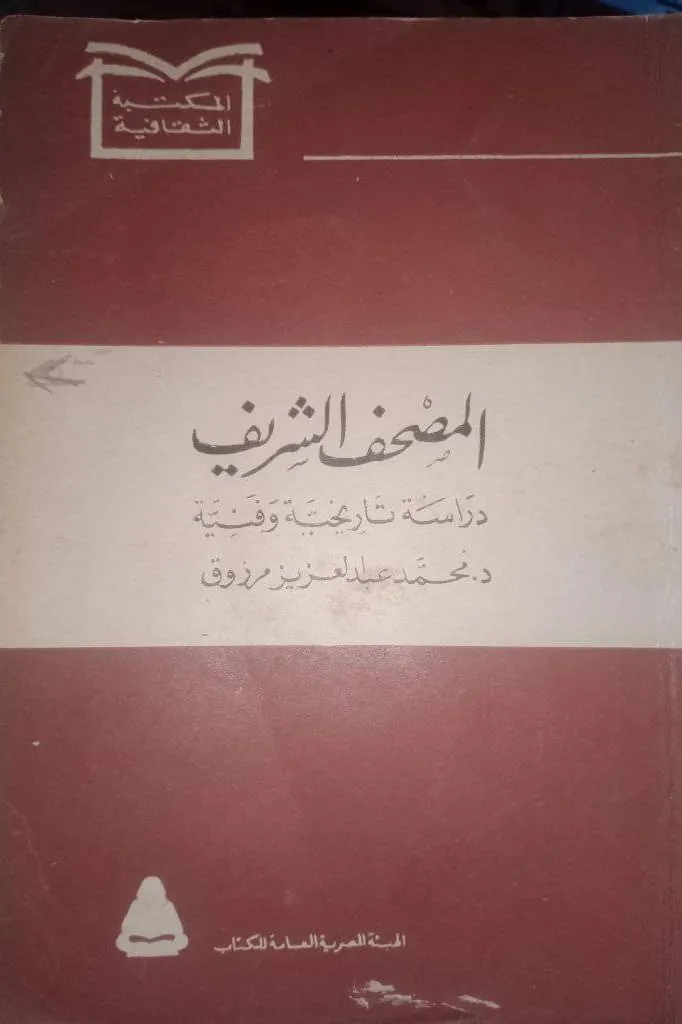
- The Western Orientalist school (codicology and paleography): it brought a qualitative leap in research methodology. Orientalists such as Martin Lings (Abu Bakr Siraj al-Din), David James, Adolf Grohmann, and François Déroche (in his studies of the Umayyad and Abbasid codices) did not rely on the bare text, but dealt with the codex as a “physical object”, using measurements, the study of ink, the nature of paper and parchment, and linking the descriptive study to images (facsimiles).
The Problem of “Academic Insinuation” versus “Arab Shortfall”
The Western institutions possess enormous funding tools, research grants, and freedom of access to manuscripts, producing large survey studies (as the publisher Brill does). Despite the precision of this research, it may carry hidden ideological orientations (“poison in the honey”), such as attempting to link the calligraphic development to doctrinal conflicts or to cast doubt on the stability of the text. In contrast, the Arab researcher suffers from scarce funding and difficulty of access to the originals, which has made many Arab academic theses lack direct visual evidence and settle for theoretical narration.
Contentious Issues and Modern Applied Models
The Sana’a Codices (the Palimpsests)
Hundreds of parchments were discovered in the ceiling of the Great Mosque of Sana’a, distinguished as “palimpsests”, parchments stripped of their original writing (scriptio inferior) and inscribed with a new text (scriptio superior).
- The Western exploitation: some Orientalists tried to use the erased text to claim the existence of a “textual evolution or unapproved recensions” of the Noble Qur’an.
- The scholarly response: Muslim scholars (among them Dr. Tayyar Altıkulaç, and Kuwaiti and Yemeni studies) established that these palimpsests were writing tablets on which students of knowledge trained and which they erased because of the costliness of parchment, and that the differences are no more than teaching exercises or anomalous, unapproved readings, not touching the mass-transmission of the ʿUthmanic text.
Modern Techniques (the Birmingham Codex)
The researcher Alba Fedeli moved the study of the Birmingham codex from paleographic description to “radiocarbon analysis” (C-14 dating); the technique proved that the parchment dates to the lifetime of the Prophet ﷺ or the era of the Rightly-Guided Caliphate, dealing a scholarly blow to the Revisionist schools of Orientalism that had claimed a late recording of the Qur’an.
A Future Road Map for Muslim Researchers
The future of Qur’anic manuscript studies requires a radical shift in the tools of the contemporary Muslim researcher, summarized as follows:
- The imperative of the visual method: today no research on the history of the codices or the scripts has value if it lacks “imaged evidence” (facsimiles); the age of studying the history of the codex theoretically is over.
- Linguistic and material armament: the Muslim researcher must master foreign languages (French and English) to contend with Orientalism on its own ground and deconstruct its theses, while mastering the tools of codicology (the science of manuscript conservation, the analysis of inks, and the types of paper and parchment).
- Discovering the new horizons (Africa and Transoxiana): focusing future research on the “African scripts” (such as the Shinqiti and Maghribi codices, and the codices of Nigeria and South Africa) and the codices of East Asia and Transoxiana; the immense diversity of these regions carries a new understanding of the civilizational spread of Islam and dispels the centric, whether Eastern or Western, view of the history of the Qur’anic script.
The burden of defending our heritage and reading it with a scrutinizing eye falls upon us. It is not enough to be dazzled by what others write; rather, we must combine our faith in the sanctity of the text with the highest standards of academic rigor, to safeguard this Book in understanding, in script, and in vessel.