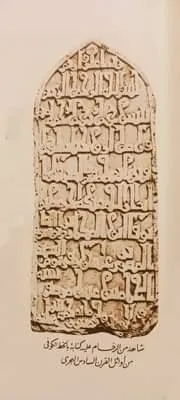
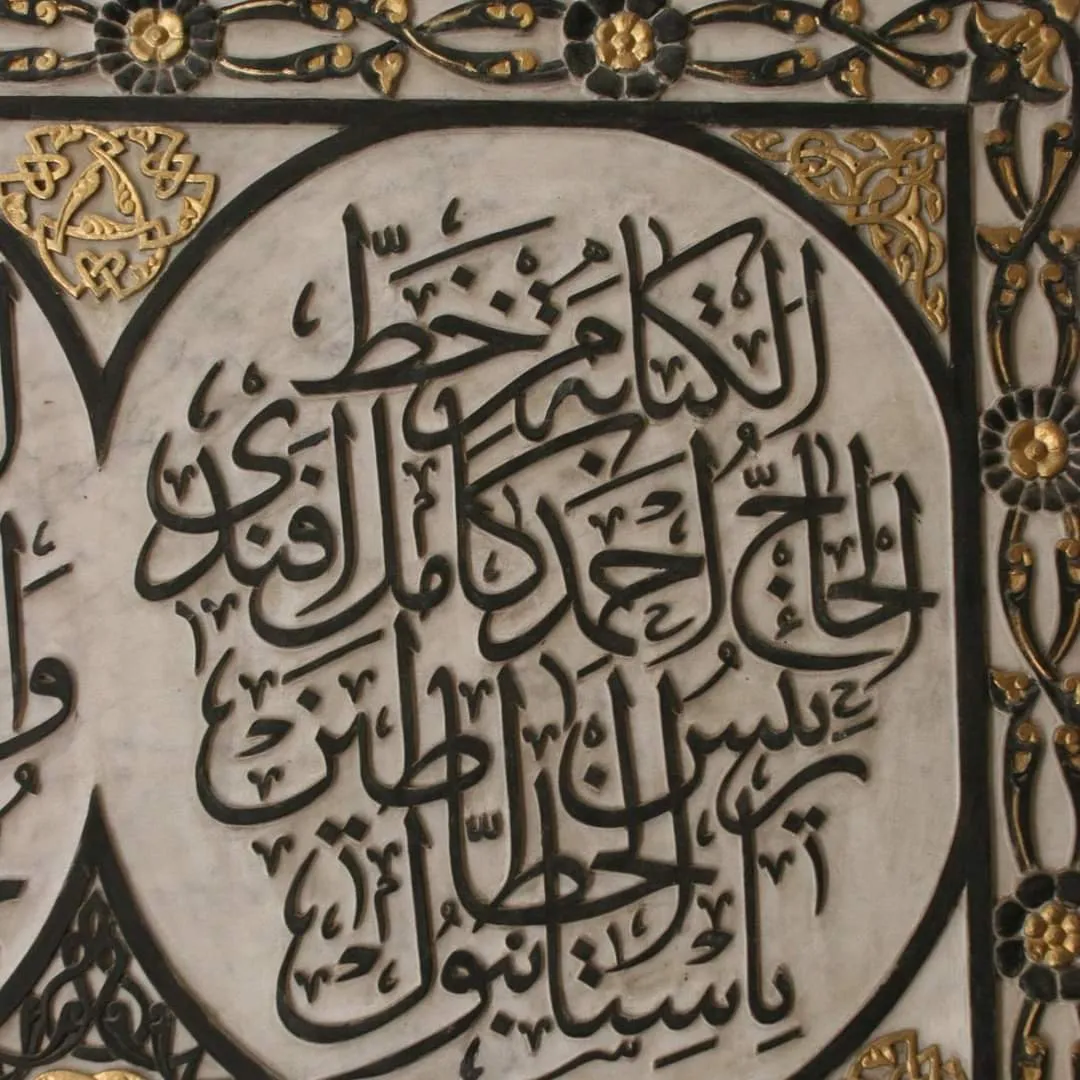
Sanglakh …
Sanglakh, the calligrapher of Muhammad Ali Pasha …
who wrote [the tombstone of] his son.
The tomb of (Ibrahim Pasha), the great conquering commander, is considered one of the most important tombs belonging to the family of the Muhammad Ali dynasty, in the complex of the royal tombs at Hawsh al-Basha.
The fusion of Arabic, Ottoman, and Persian language, scripts, and ornament, the writings of Sanglakh al-Khurasani on this tomb in particular …
are all evidence of the state of the art whose forms Muhammad Ali Pasha codified through his ideas and choices. And the intellectual source from which we can understand the thought of Muhammad Ali, and be certain that these practices were not arbitrary, …
is the book (The Orders and Correspondence Issued by the ʿAziz of Egypt, Muhammad Ali), published by the Egyptian National Library under the care of Prof. Dr. Raʾuf ʿAbbas. I later learned that this book had belonged to one of the “Italian” historians from the era of King Fuad, who selected a group of documents bearing the responses, ideas, and orders of Muhammad Ali Pasha …
whether concerning agriculture, industry, or commerce …
What matters in this unique source …
is that the movements and trends of art and architecture during the period of Muhammad Ali were not random, but were planned, and planned well. Muhammad Ali’s love of Islamic antiquities had a wide and notable echo in his orders, unlike the ancient Egyptian antiquities, which did not receive such attention …
Architecture and the arts were present, and strongly so, in the thought of Muhammad Ali Pasha …
for he saw himself as an extension of the march of the great ones of world history, such as Alexander the Great and the Ptolemies … and architecture is the visible history affirming his age and his power within it.
The tombstone is made of marble, and you are struck with amazement at the amount of time the work on this tomb in particular took: three years …
yes, three full years: the difference between the date of the text of the inscriptions on the tombstone and the Qur’anic verses, dated (1267 AH / 1849 CE), and the text marking the completion of the assembly, dated (1270 AH / 1850 CE) …
whose text came in the Arabic script, the Ottoman language, and the Persian Nastaʿliq script, as follows: 1- In the reign of the sultan of the sultans of the age 2- and the khaqan of the khaqans of the world …
(“It was the first time I learned the plural of khaqan: khawaqin.”) 3- ʿAbd al-Majid Khan, may God perpetuate his reign 4- this well-composed assembly 5- beside the resting place of Ibrahim Pasha 6- his esteemed sons 7- Ahmad Pasha and Ismail Pasha 8- and his excellency Mustafa Pasha, in the year 1270 9- was adorned and brought to full completion 10- written by Sanglakh al-Khurasani …
The letters raised in the Nastaʿliq script on this tombstone …
Indeed, the building and assembly of this tombstone required demolishing one of the walls of Hawsh al-Basha and rebuilding it. That was the answer I understood from the foundation text of the tomb …
Finally …
Sanglakh means “the rock,” and the correct spelling of the name is: Sanglakh; the “conditioned kaf” (گ) is pronounced (g) in Persian.
And we shall have a closer pause with Sanglakh … the self-assured Sufi artist whose presence in Egypt made a difference, in the engraving of printing type, in design, and in calligraphy.