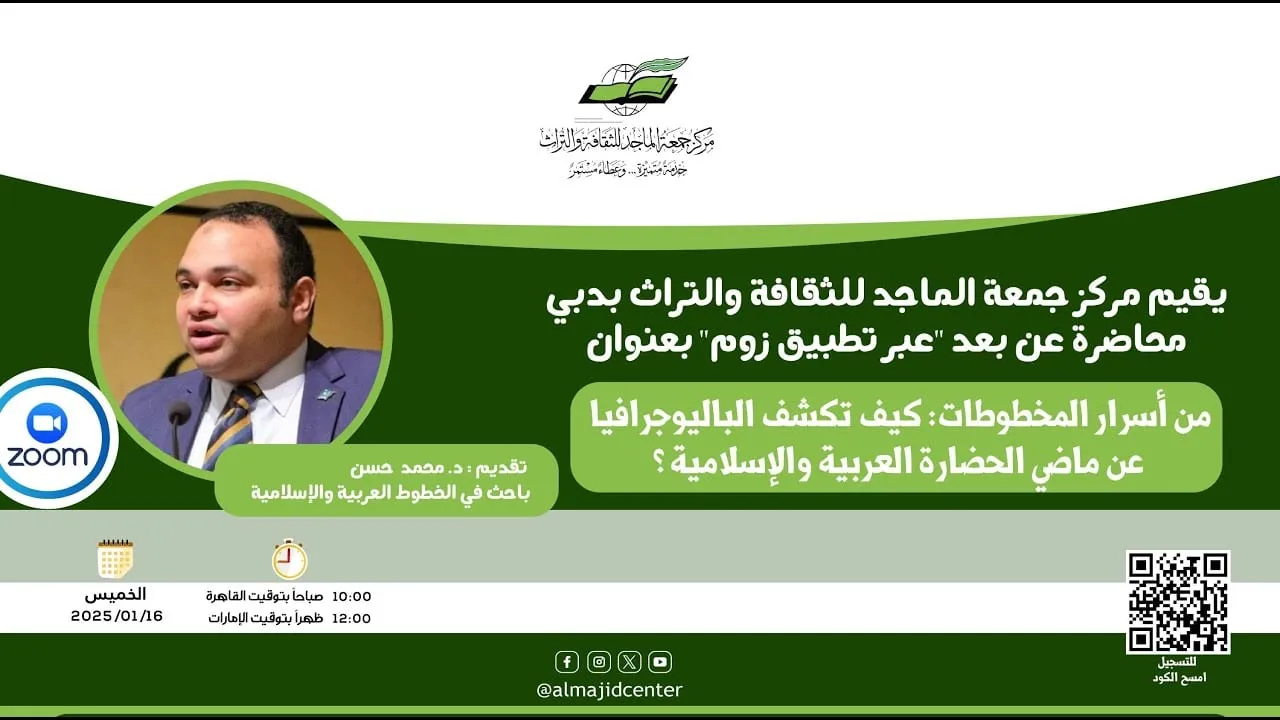
This lecture was delivered at the Qatar National Library in collaboration with the Center for the Study of Manuscripts at Fatih Sultan Mehmet University in Istanbul, within the Manuscript Studies Lecture Series, and was presented by Dr. Mohamed Hassan Ismail (senior specialist at the Center for Arabic Calligraphy Studies at the Bibliotheca Alexandrina), introduced and moderated by Mr. Mahmoud Zaki. What follows is a structured record of its main themes, allowing it to be read as a text alongside watching it in full in the video above.
The Pillars of Manuscript Production
The production of the Arabic manuscript rests fundamentally on four main pillars:
- Paper-making.
- The composition of ink.
- The copying of the manuscript (the scripts).
- The binding of the manuscript.
This lecture comes to shed light on the third pillar, “the copying of the manuscript”, from the perspective of the science of paleography, away from the purely aesthetic-artistic view (the science of fine calligraphy), and focusing on the scripts of the ordinary stationers and copyists, and how to read them, deal with them, and determine their geographical and temporal identity.
The Importance of Paleography for the Historian and the Editor
Dr. Mohamed Hassan Ismail opened his talk by referring to the academic authority of the late Prof. Muhammad Amin, affirming a fundamental rule:
No researcher can be a scholar of the history or the civilization of Arab-Islamic society, or comprehend Orientalism, unless he has a specialization and an authentic understanding of the science of paleography (the science of scripts and their development).
The lecture was divided into four main themes.
Theme One: The Nature and Definition
Returning to the Arabic dictionaries (such as al-Muʿjam al-Kabir, the Dictionary of Language and Literature Terms by Magdy Wahba, and the dictionary of Dr. Afif Bahnassi), we find a divergence in defining paleography between considering it an “art,” a “study,” or a “science.” A comprehensive definition of it in the Arab-Islamic context may be formulated as:
The science, study, and artistic practice concerned with the historical and analytical reading of the development of scripts on flexible media (such as paper and parchment).
A methodological note: a distinction must be drawn between “paleography,” which is concerned with texts on flexible media, and the science of studying inscriptions on buildings and hard materials (inscriptions / epigraphy).
The Orientalist schools gave this science early attention, and important reference works appeared, such as:
- The album of George Vajda (Album de Paléographie Arabe).
- The comparative studies of Adolf Grohmann.
- The works of Bernhard Moritz on the Arabic collections (Arabic Paleography).
Theme Two: Between the Hijazi and the Kufic (the Rigid Scripts)
The transition from the Hijazi script to the Kufic script represents a development of the family of the “rigid/dry scripts” that rely on geometric forms:
- Historical development: the Kufic script is the refined heir of the Hijazi script, which in turn inherited the Nabataean inscriptions.
- The script of a world civilization: Kufic was not merely a sacred script for writing the codices, but a script of Arab-Islamic civilization that extended for three centuries, in which Gospel commentaries, amulets, and various inscriptions were recorded.
Case Study: The Codices Attributed to ʿUthman ibn ʿAffan
To study paleography practically, one must possess a “visual memory” to distinguish between manuscripts. Looking at the six codices attributed to our master ʿUthman (in Cairo, Istanbul, Tashkent, Saint Petersburg, and elsewhere), the paleographer studies the details of the design (page layout):
- The format (vertical or horizontal).
- The distinction between the recto and the verso of the manuscript in terms of the density of the ink resulting from the nature of the parchment (the hair side versus the flesh/fatty side).
- The appearance of outlining processes and the use of different inks for ornamentation.
- The interstitial spaces between the sections and words (density and looseness).
Theme Three: The Naskh Script and the Beginning of Recording (the Supple Scripts)
The Naskh script represents the second documentary foundation, and it belongs to the family of the “supple/flexible scripts.” To understand the Naskh scripts, they must be viewed through two orders:
- The geographical order (the Naskh schools): the Baghdadi Abbasid school, the Egyptian-Levantine (Mamluk) school, the Maghribi and Sudanese (African) school, the Persian school, the Indian school (the Bihari script), and the Chinese school.
- The functional order: the use of particular scripts for specific functions (such as recording the chancery registers, the codices, or the main texts).
Practical Copying and the Scripts of the Scholars
The lecturer distinguished between “copying (nisakha) as a functional term” and “Naskh as an artistic term,” pointing to the importance of specializing in “the scripts of the scholars” (such as the scripts of al-Maqrizi, Ibn Khaldun, and Ibn Iyas). Recognizing the original author’s script (autograph), his notes, and his marginalia is a higher paleographic skill, and many researchers have contributed to this field (such as Dr. Ayman Fuad Sayyid, Dr. Muhammad Sariʿ, and Mr. Tamer al-Gibali).
An important paleographic rule: paleography does not judge manuscripts aesthetically; the Eastern script is not better or worse than the African or the Chinese script; rather, each script is the product of a civilization and a culture that must be understood within its independent geographical and temporal space.
Theme Four: The Pioneers of Calligraphy and the Maghribi Scripts
The engineering of the Arabic letter passed through decisive milestones founded by the luminaries of calligraphy:
- The vizier Ibn Muqla: the first to engineer the letter and to devise the terms of aesthetic measurement (tawfiya, itmam, ikmal, ishbaʿ, and irsal).
- Ibn al-Bawwab: he applied Ibn Muqla’s theory practically, and his codex (dated 391 AH and preserved in the Chester Beatty Library) is considered the first codex written on paper in the Abbasid Naskh script.
- Yaqut al-Mustaʿsimi: he established the term “the six pens” (Muhaqqaq, Rayhan, Naskh, Riqāʿ, Thuluth, and Tawqiʿ).
A Note on the Maghribi Scripts
The region of the Islamic West (North and West Africa) represents an important geographical extension that reflects the same Eastern aesthetic mindset but with different applications. Among the most prominent types of Maghribi scripts:
- Maghribi Kufic (Qayrawani).
- The Mabsut script (the equivalent of Naskh, used in the codices).
- The Mujawhar script (for writing documents and letters).
- Maghribi Thuluth (for titles and panels).
- The Zimami script (the rapid recording script of the scholars).
- The Sudani script (in the regions of West Africa).
Despite the differences in the forms of the letters (such as the bowls, the alifs, and the lāms, or their being free of the “veined” vocalization), the governing geometric balance in the Maghrib and the East springs from a single artistic origin.
Question-and-Answer Session
The event concluded with a discussion moderated by Mr. Mahmoud Zaki, addressing the following points:
- The ʿUthmanic codices: the codices attributed to ʿUthman ibn ʿAffan were not written directly in his era, but rather date to later centuries (the second, third, and beyond), or were copied in the “ʿUthmanic orthography.” The actually older manuscripts were written in the Hijazi script (Meccan and Madani) and are marked by certain characteristics, such as the alifs leaning to the right.
- Vocalization and pointing in the early codices: the grammatical additions (case-vowel marks) or the letter-distinguishing dots that appear on some old codices are mostly later additions placed by subsequent readers to facilitate reading, which can be proven by the chemical analysis of the ink differences; noting that “dotting” and “vocalization” existed early on but were partial and irregular.
- The Qayrawani and Andalusi scripts: the Qayrawani script is a rigid geometric script springing from Kufic (derived mainly from the codex of the wet-nurse of al-Muʿizz ibn Badis al-Sanhaji), whereas the Andalusi script is a supple script belonging to the “Naskh” family, and comparisons are drawn between it and the Maghribi Mabsut script.
- References for learning: researchers were advised to follow the publications of the Institute of Arabic Manuscripts, the translations of the research of Adam Gacek and François Déroche, the publications of the Center for Manuscripts at the Bibliotheca Alexandrina, the catalogues of the Al-Furqan Islamic Heritage Foundation, and the catalogues of Dr. Qasim al-Samarrai and Dr. Mahmoud Dagheem, for the precise description they contain supported by rare facsimiles.
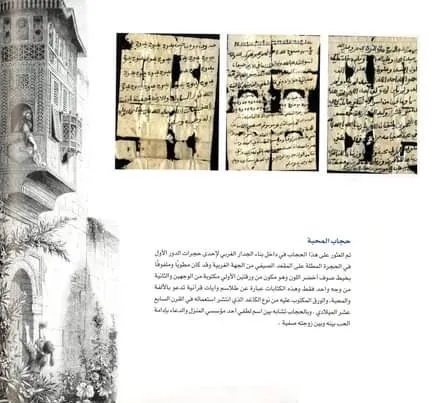
A closing recommendation: the lecturer directed a message to researchers and cataloguers about the importance of attaching high-quality images of the manuscripts in the catalogues and edited publications, because “the image” is what builds the visual memory and helps researchers to complete the journey of studying “Arabic paleography.”